
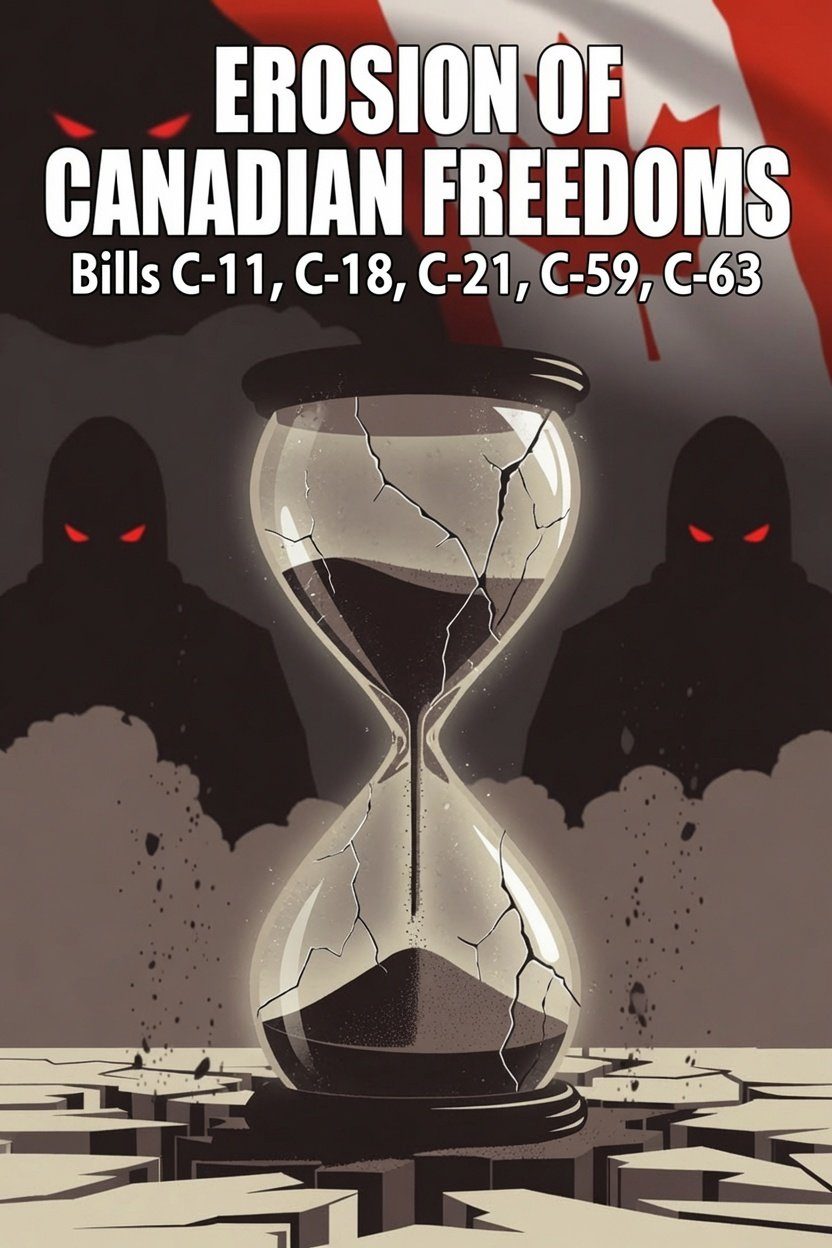
Section 2(b) of the Canadian Charter of Rights and Freedoms guarantees "freedom of thought, belief, opinion and expression." Section 8 protects against unreasonable search and seizure. These aren't recent additions — they're foundational. Over the past several years, I believe a pattern has emerged across five pieces of federal legislation — Bills C-11, C-18, C-21, C-59, and C-63 (and its successors) — that, taken individually, each have a defensible stated purpose, but that, taken together, represent a sustained expansion of state and bureaucratic reach into what Canadians can stream, read, own, and say. I want to make that case carefully, bill by bill, rather than treat all five as interchangeable evidence of the same villain.
"Freedom of expression does not truly begin until it gives rise to a duty to tolerate what other people say."
I want to flag the most important correction up front, because getting this wrong undermines everything that follows: Bill C-63 itself never became law. It died on the order paper when Parliament was prorogued on January 6, 2025.[1] Treating it today as live, pending legislation — as a lot of commentary on this topic still does — is simply inaccurate. What actually happened is that its most contentious provisions were split into two successor bills: Bill C-9 (the Combatting Hate Act), which passed and received Royal Assent in June 2026, and Bill C-34 (the Safe Social Media Act), introduced in June 2026 and still working through the House of Commons as of this writing.[2] I cover both successor bills below, since they're where C-63's actual legal substance now lives.
I also want to flag that Bill C-59 is not part of the same recent legislative wave as the others. It received Royal Assent in June 2019, predating C-11, C-18, C-21, and C-63 by years.[3] I'm including it because I think the surveillance powers it created are a genuine, still-relevant piece of the larger pattern — but I'm not going to pretend it's part of a single recent legislative session just because it's convenient for the narrative.
1C-11: Who Decides What You See?
The Online Streaming Act received Royal Assent on April 27, 2023. It brings online streaming services under the Broadcasting Act, giving the CRTC authority to impose Canadian-content spending requirements and "discoverability" obligations on platforms like Netflix, YouTube, and Spotify.[4]
I want to be accurate about a specific, frequently misstated point: the version of C-11 that passed includes an explicit exemption for individual users and the content they upload to social media — section 4.1 states that the Act does not apply to a "program that is uploaded... by the user of a social media service" for that user to be regulated as a broadcaster.[5] So the law does not directly regulate what an individual creator posts. What it does regulate is how platforms must algorithmically surface content — and that's where the real critique lives. OpenMedia and the Centre for International Governance Innovation have both pointed out that because the discoverability requirement applies to the platform's overall feed and recommendation systems, a creator's content can still be algorithmically deprioritized for not meeting CanCon criteria, even though the creator personally isn't "regulated."[5,6] University of Ottawa law professor Michael Geist, who testified against the bill repeatedly at committee, has also noted that years after passage, there's been no demonstrated funding crisis it needed to solve — Canadian film and television production hit record levels before the Act even took effect.[7] I think that's a fair question to sit with: if the stated emergency wasn't actually there, what was the CRTC's expanded discretion actually for?
2C-18: A Law That Made News Harder to Find
The Online News Act received Royal Assent on June 22, 2023. It requires large platforms to negotiate payment with Canadian news publishers for content they link to or "facilitate access" to.[8] The practical result wasn't what the bill's authors intended. Meta responded by permanently blocking all news links — Canadian and foreign — on Facebook and Instagram in Canada, a block that has now lasted years.[9] A 2025 report from the Centre for Media, Technology and Democracy found the ban removed an estimated 11 million daily views of journalism in Canada.[10] Reporters Without Borders cited the Online News Act and Meta's response to it as a contributing factor when Canada dropped seven spots on the World Press Freedom Index between 2024 and 2025.[11] Google, unlike Meta, negotiated an exemption: a $100-million annual payment to a CRTC-administered fund, in exchange for not blocking news links.[12]
I think the honest assessment here is that the law produced the opposite of its stated goal for a huge share of the Canadians who relied on Facebook and Instagram for news. Whatever one thinks of Meta's decision, the law gave the company a clean financial incentive to simply stop carrying Canadian journalism rather than pay for it, and that's exactly what happened, for years, with no resolution. A law intended to strengthen access to Canadian journalism instead measurably reduced it.
3C-21: A More Complicated Picture Than Either Side Admits
Bill C-21 received Royal Assent on December 15, 2023. I want to represent this one more carefully than the others, because I think both the government's defenders and its critics regularly overstate their case. The bill codifies the national handgun freeze into law, creates a forward-looking technical definition banning newly designed "assault-style" firearms, increases penalties for firearms trafficking and smuggling from 10 to 14 years, and creates new "red flag" and "yellow flag" provisions allowing courts to temporarily remove firearms from people who pose a risk to themselves or others, including in cases of intimate partner violence.[13]
It is not, as it's sometimes described, a ban on hunting rifles — it targets handguns specifically and a narrow, prospective category of newly designed firearms, not existing long guns used for hunting.[14] I think critics who suggest otherwise are misdescribing the bill. But I also think the bill's defenders understate a real, distinct concern: the Assembly of First Nations told the Senate committee studying the bill that First Nations leadership were not adequately consulted, and that the red-flag and yellow-flag provisions risk infringing inherent and treaty rights to hunt, particularly the discretion given to Chief Firearms Officers without a clear oversight mechanism.[15] The Canadian Coalition for Firearm Rights, meanwhile, has focused its objection less on the assault-style ban and more on the burden the handgun freeze and compensation scheme place on licensed, already-vetted owners — including the position police are put in to confiscate handguns from the estates of deceased licence holders.[16] I think the legitimate version of this critique is about whether the law's tools are well-targeted at the actual sources of gun violence — which polling and the government's own statistics suggest are disproportionately smuggled and illegally manufactured firearms rather than legally owned, registered handguns — not whether the bill "disarms law-abiding citizens" wholesale, which I don't think is an accurate description of what it does.
4C-59: The Surveillance Powers Already on the Books
Bill C-59 received Royal Assent in June 2019. It's the oldest bill in this essay, and I think it's worth including precisely because its powers are still in force and still relevant, even though it predates the current wave of online-speech legislation by years. The Act created CSIS's authority to collect and retain "datasets" — including ones with no direct connection to an identified security threat — and gave the Communications Security Establishment a new mandate for "active cyber operations," authorizing state-sponsored hacking for the first time in Canadian history.[17] The Canadian Civil Liberties Association's assessment at the time was direct: the bill "leaves open the possibility that CSIS agents may request warrants for otherwise illegal, rights-infringing actions, in a secret hearing," and the new "publicly available information" exception for CSE data collection has "troubling implications for privacy rights."[18] Citizen Lab researchers separately warned that the active cyber operations mandate, with its limited safeguards, could disproportionately affect human rights defenders and civil society groups, and risk weakening the security of the broader internet by normalizing state-sponsored exploitation of vulnerabilities.[19]
C-59 did also create real, positive accountability structures — a National Security and Intelligence Review Agency with broad authority to review CSIS and CSE's lawfulness, and an independent Intelligence Commissioner.[20] I think it's fair to note that, unlike some of the bills below, C-59 was at least partly a response to legitimate criticism of its predecessor, Bill C-51. But the underlying disruption and dataset powers survived that response largely intact, and I think the privacy and oversight concerns raised at the time remain unresolved years later.
5C-63 and Its Successors: The Speech Provisions
This is the piece of the pattern I think deserves the most scrutiny, and I've covered the current state of C-9 and C-34 in detail in a separate essay on this site, so I'll summarize here rather than duplicate it.[21] Bill C-9, now law, removed the 55-year-old requirement that hate-propaganda charges receive a provincial Attorney General's consent before proceeding, and removed the "good faith religious expression" defence from the Criminal Code's hate speech provisions.[22] Bill C-34, still pending, would create a Digital Safety Commission with the power to investigate, summon witnesses, and levy fines up to 5% of a platform's global revenue — while leaving most of what actually counts as a "regulated service" or an "adequate safeguard" to regulations the Commission will write later, not to the statute Parliament is being asked to vote on.[23]
I think the single most credible warning about the original C-63 framework came from former Chief Justice Beverley McLachlin, who stated publicly that the bill's hate-speech provisions would likely face constitutional challenges if enacted.[24] That's notable because McLachlin isn't a partisan critic of hate-speech law in general — as a puisne justice in 1990, she wrote the dissenting opinion in R. v. Keegstra warning specifically that the subjectivity of the word "hatred" creates a real risk that "the law-abiding citizen who does not wish to run afoul of the law will decide not to take the chance" and self-censor speech that was never actually unlawful.[25] When a former Chief Justice who has spent decades thinking carefully about exactly this tension flags it again, three decades later, about a new bill, I think that carries real weight — regardless of where I personally land on any individual hate-crime prosecution.
6The Pattern, Stated Carefully
I don't think every one of these five bills is equally troubling, and I don't think they were all drafted with the same intent. C-21 has real public-safety provisions — the red-flag laws and the smuggling penalties — that I think are defensible even if the consultation process was inadequate. C-59 created genuine oversight bodies alongside its surveillance powers. C-11 carved out an explicit exemption for individual users, even if the practical algorithmic effect is more complicated than that exemption suggests.
What I think connects all five, including the ones with real merit, is a recurring design choice: each one creates broad discretionary power — for the CRTC, for a Digital Safety Commission, for CSIS and CSE, for Chief Firearms Officers — and resolves the details later, through regulation, rather than settling them in the statute Parliament actually debates and votes on. That's not unique to any one government or any one bill. But across five bills over roughly seven years, I think it adds up to a meaningful, accumulating transfer of judgment away from elected representatives and toward appointed officials and regulators — which is exactly the kind of change that's easy to wave through one bill at a time and hard to reverse once it's spread across five.
7What I Think Should Change
- Write substantive rules into statutes, not into regulations decided later by appointed commissions — true of C-11's discoverability standards, C-34's "regulated service" definition, and CSIS's dataset retention categories under C-59 alike.
- Restore the Attorney General consent requirement for hate-propaganda charges that C-9 removed, and reinstate a narrowly tailored good-faith expression defence.
- Revisit C-18's bargaining model given its measurable, multi-year failure to increase Canadians' access to news — a funded-journalism model, like the one Google ultimately negotiated, appears to have worked better than the law's original mandatory-bargaining design.
- Build real, independent consultation into firearms regulation affecting Indigenous treaty rights, with a clear appeals mechanism for Chief Firearms Officer discretion under C-21.
- Sunset and re-justify expansive national-security powers on a fixed timeline, rather than leaving CSIS and CSE's 2019 dataset and cyber-operations authorities permanently in place without periodic public re-examination.
I think Canadians can want safer communities, a sustainable news industry, and protection from genuine hate-motivated violence — all legitimate goals behind these bills — without accepting that each new tool toward those goals has to come bundled with broad, loosely defined discretion for whoever holds the regulatory pen next.